
Escrow Software Trusteeship
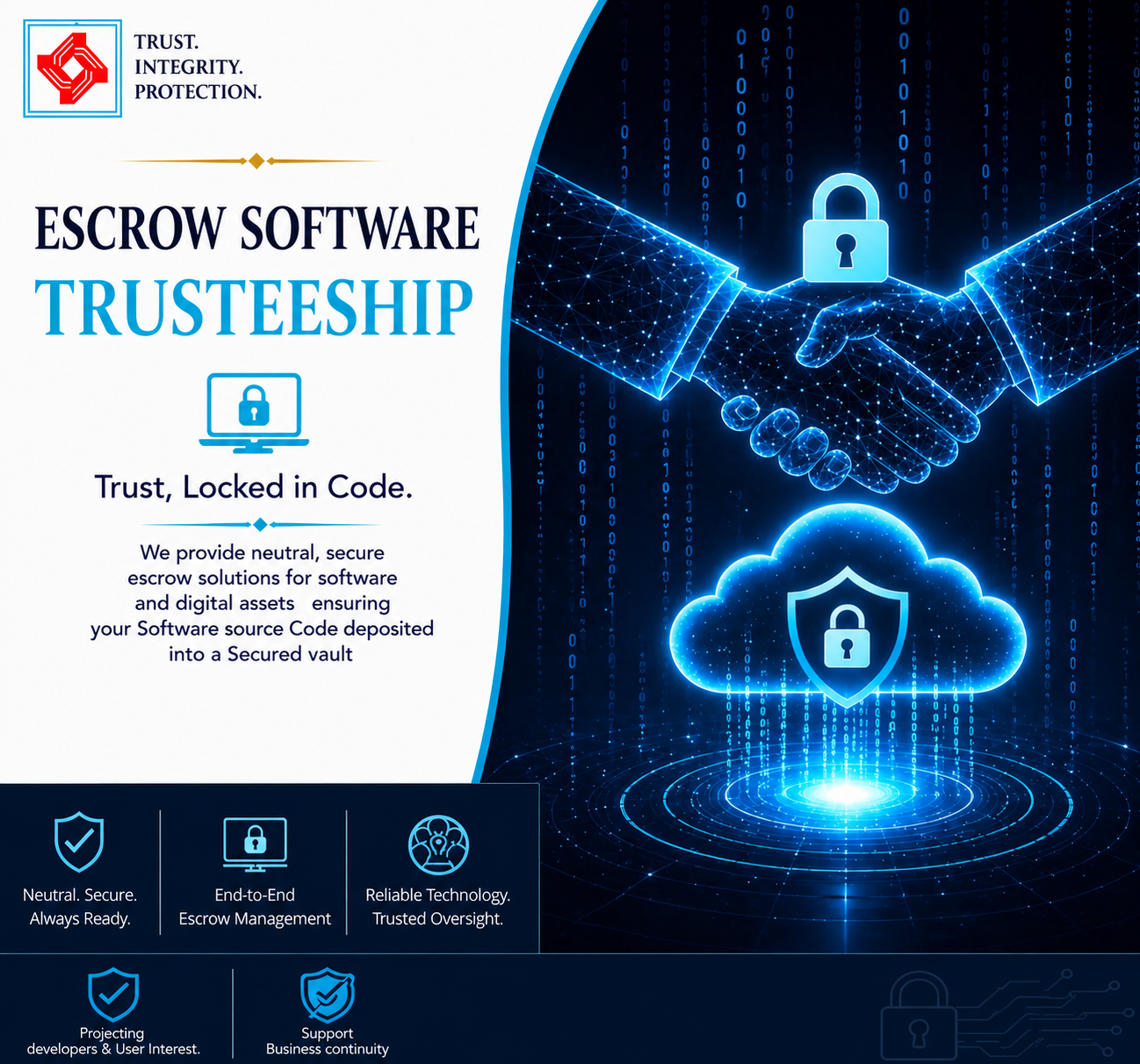
An arrangement where a neutral trustee securely holds a software’s source code and related assets to ensure beneficiary access and business continuity in line with RBI guidelines.
Role
- Acts as a neutral custodian holding the source code, documentation and keys of critical software applications.
- Ensures business continuity and access rights in the event of vendor default, insolvency or dispute.
- Operates under RBI’s governance and risk management guidelines for technology dependency and third-party risk.
Functions
- Executes and manages escrow agreements between the software developer, beneficiary (licensee) and trustee.
- Securely stores source code and related materials in physical or digital form.
- Releases the escrowed materials to the beneficiary upon predefined trigger events, as per RBI-compliant terms.
- Conducts periodic verification and updates of deposited software versions.
- Ensures confidentiality and compliance with data protection and regulatory norms.
How the Software Escrow Mechanism Works
Tripartite agreement · Deposit · Verification · Secure storage · Conditional release
Vendor
Software Developer
- Deposits complete source code, build instructions and documentation.
- Keeps the escrow deposit updated with each material release.
- Is bound by the terms of the tripartite escrow agreement.
CFSL
Escrow Agent / Trustee
- Acts as an independent, neutral trustee without a conflict of interest.
- Holds escrowed materials in strict confidence.
- Verifies completeness and integrity through technical partners, where optional verification is agreed.
- Releases materials only upon objective verification of the agreed release event.
User / Buyer
Financial Institution
- May be a bank, NBFC, insurance company or payment company.
- Is the beneficiary of escrow protection.
- Gains the right to access source code upon an agreed release event.
- Benefits from business continuity support for critical applications.
Step-by-Step Process Flow
Agreement Execution
Execution of tripartite Software Escrow Agreement.
Source Code Deposit
The vendor deposits complete source code, build tools and documentation.
Verification
Verifies the completeness, integrity and usability of the deposited materials where this service is agreed.
Secure Storage
Materials are stored physically on encrypted media or digitally in encrypted cloud storage, according to the agreed protocol.
Periodic Updates
The vendor updates the deposit with each material change, and verifies that the deposit is up to date.
Release Event
When a trigger occurs, objectively verifies the event and releases the code to the User / Buyer according to the agreement.
Key Benefits to User / Buyer
Business Continuity Assurance
Supports continued access to mission-critical software operations if the vendor fails, through the agreed escrow and release arrangements.
Operational & Technology Risk Mitigation
Supports proactive management of IT dependency and third-party technology risks in line with applicable governance requirements.
Reduced Vendor Lock-in
Reduces dependency on a single vendor by providing agreed access to the materials needed to operate independently.
Enhanced Regulatory Compliance
Supports applicable RBI, cyber resilience, IRDAI and SEBI requirements through documented escrow controls, verification and release arrangements.
Vendor-Buyer Trust Equilibrium
Creates balanced contractual protection: vendors retain protection for their intellectual property, while buyers gain continuity support.
Protection Against Sudden Disruption
Helps address disruption risks arising from vendor service interruptions, cyberattacks or geopolitical events through agreed continuity arrangements.
Let us discuss your requirements.
Connect with CFSL for service scope, documentation and next steps.